Common Membrane Switch Terminology

Common Membrane Switch Terminology

ACTUATION FORCE

The pressure required for actuating the circuit of a membrane switch or rubber keypad.

ADHESION

The strength of the molecular attraction bond of one material to another determined by the surface energy in each material.

BACKERS

Incorporating backers into membrane switch assemblies for mounting or rigidity purposes. The most commonly used material is aluminum which can be supplied with a variety of hardware installed. Other backer options include G10, stainless steel, polycarbonate or acrylic materials.

BACKLIGHTING

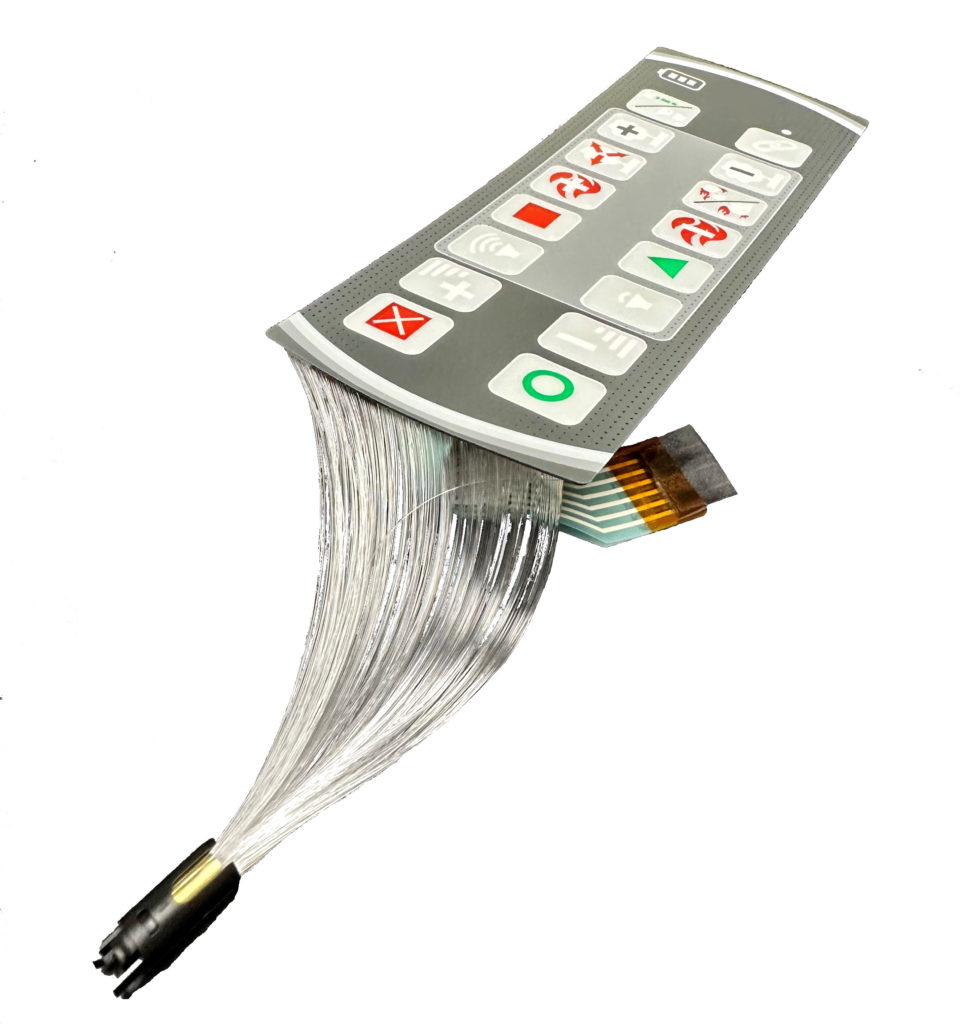
Lighting of membrane switches using LEDs, light guide film, fiber optics or EL panels.

BREAKDOWN VOLTAGE

The minimum voltage at which the insulation between two conductors begins to fail.

CARBON OVERCOAT

Ink that consists of prepared suspensions of carbon black and is applied over silver circuitry to mitigate the possibility of silver migration. Typically used on the flex tail contacts which is the area on the flex circuit most susceptible to silver migration.

CIRCUITRY

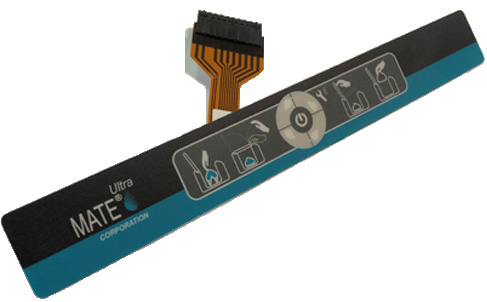
Electrical circuit used to operate a membrane switch typically either printed silver, copper flex or printed circuit board based.

CONDUCTIVITY

A material’s ability to allow the flow of electrons.

COPPER FLEX

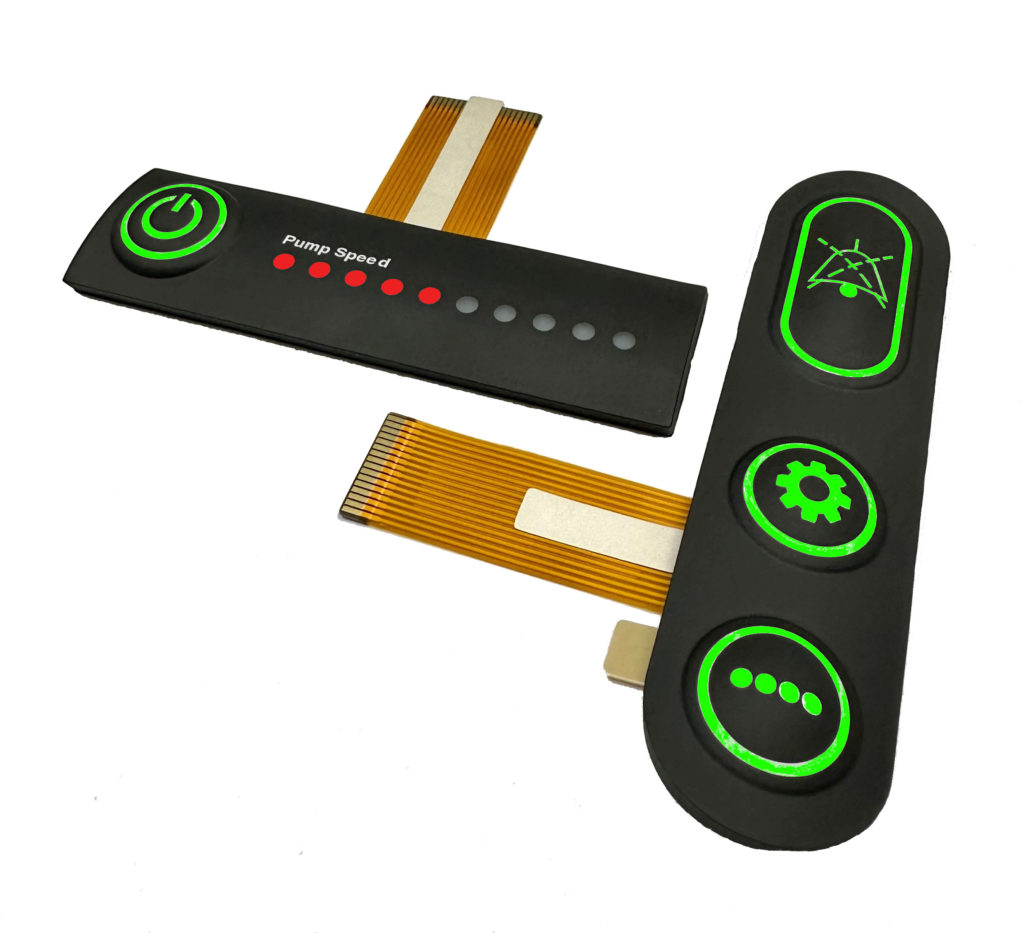
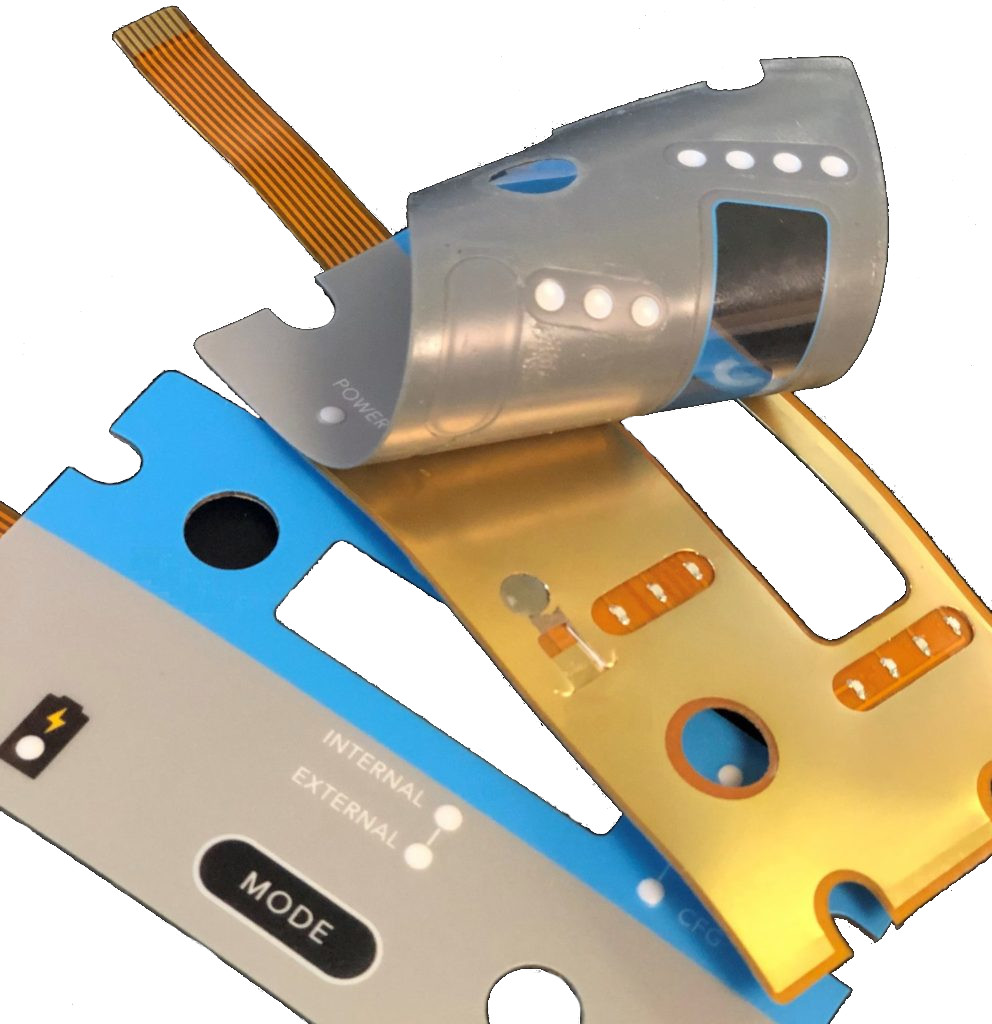
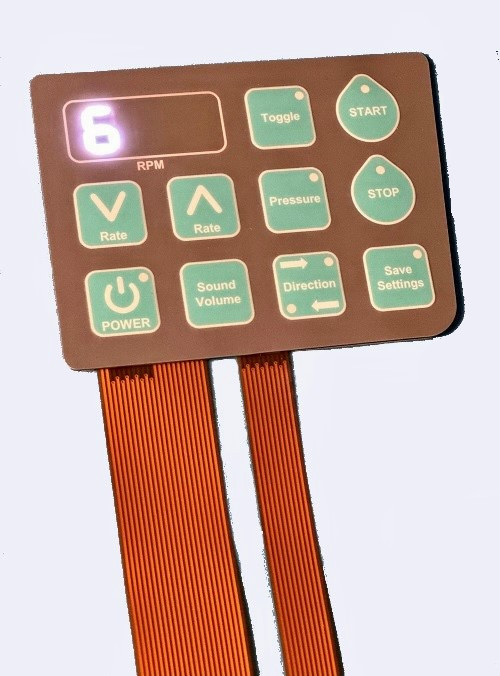
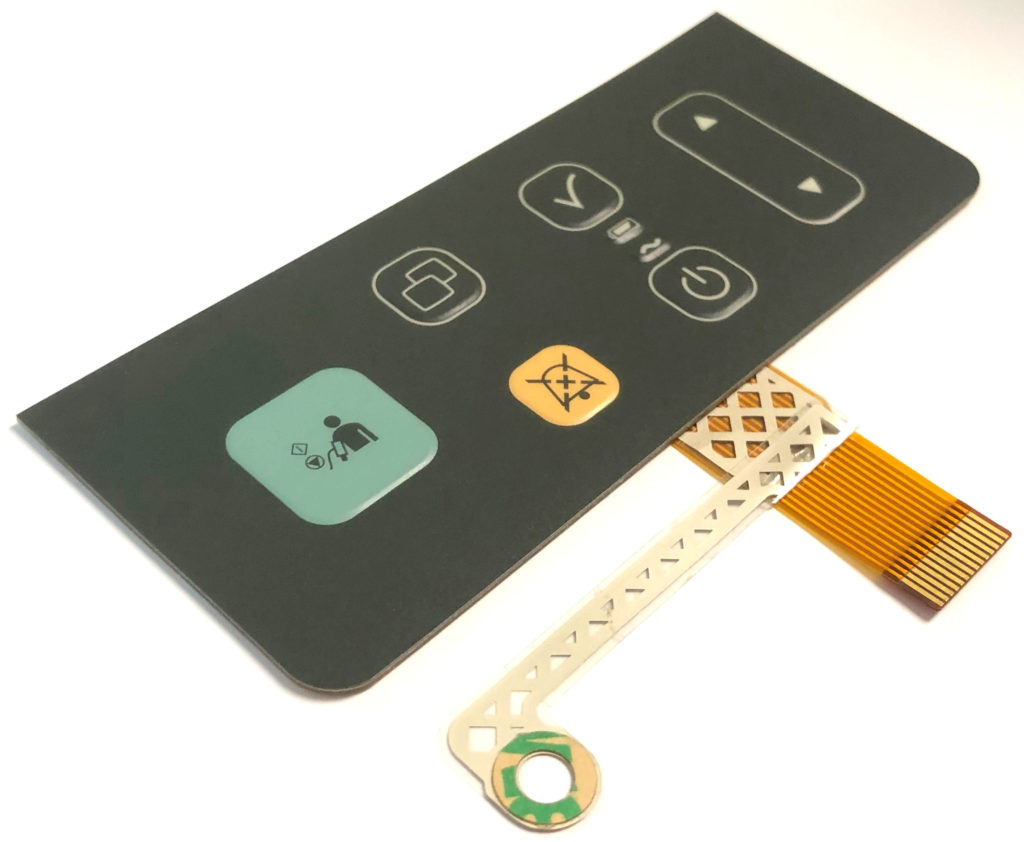
A type of circuitry used in membrane switches produced using polyimide (Kapton) as the base material. Manufactured by laminating a thin sheet of copper to a flexible film substrate, the copper is then chemically etched away, leaving the copper traces. An additional layer of polyimide is laminated to the circuit leaving the gold contacts exposed. Also known as Kapton circuits, they have become the superior choice over printed silver especially for outdoor applications due to their excellent dielectric strength, thermal stability, chemical resistance and flexibility.

CROSS-OVER

A conductor intersection where the traces are kept separated and insulated by dielectric material insulator.

DEAD FRONT

A cosmetic feature of a graphic overlay in which an artwork feature is only visible when backlit.

DIELECTRIC / DIELECTRIC INKS

An insulating or non-conducting medium. The inks are used for printing protective patterns on conductive printing to isolate selected areas from electrical contact with other conductors. Typically used for cross-overs and tail insulation.

DOMES

A tactile metal dome (or a snap dome) is a normally open momentary contact that provides a crisp tactile feel letting the user know the button was pressed/actuated. Polydomes can also be utilized if necessary.

DOME RETAINER

An adhesive layer made to hold metal domes in the key-switch.

EMBOSS

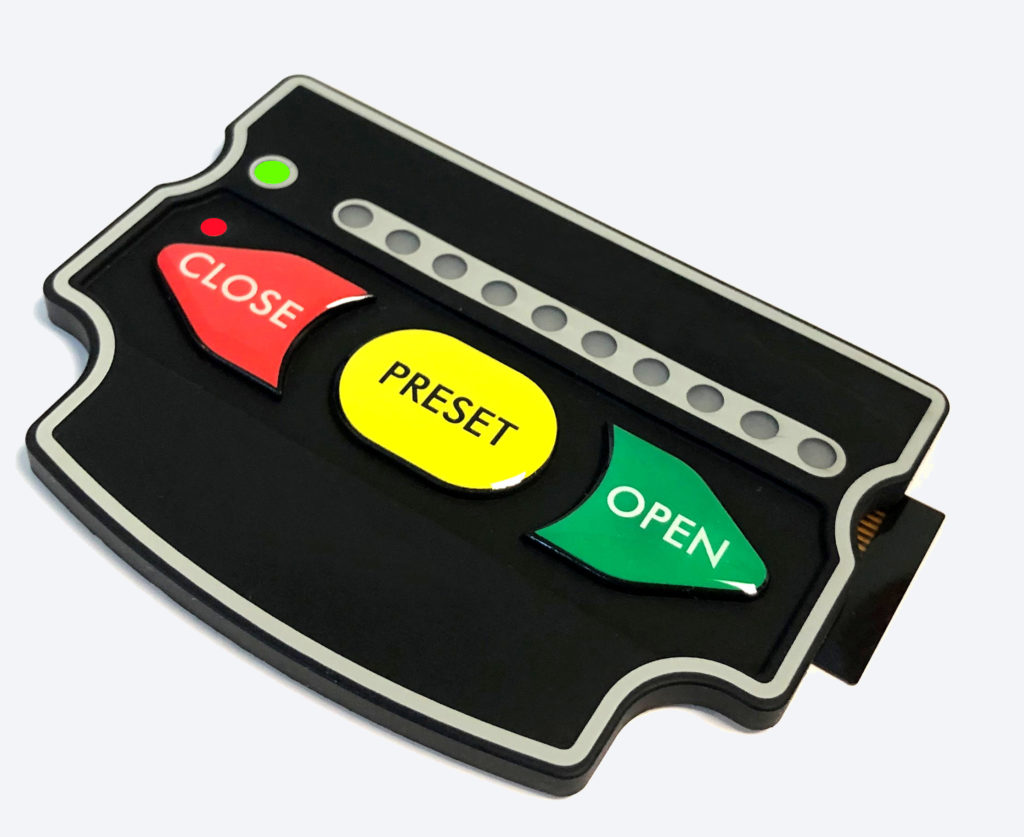
Method of raising an aspect or aspects of the overlay material to accentuate key surfaces through mechanical and thermoforming of graphical features. Typically used for keys and/or LED indicators.

ENVIRONMENTAL SEALING

Utilizing proprietary design features in order to seal a membrane switch or rubber keypad. Such features include frame sealing, the use of copper flex circuitry and rubber gasketing.

GRAPHIC OVERLAY

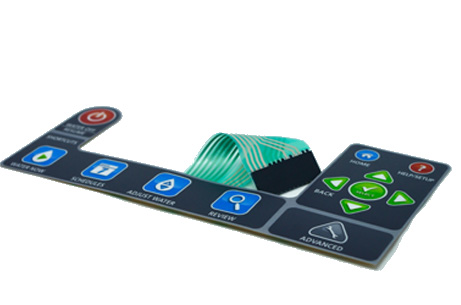
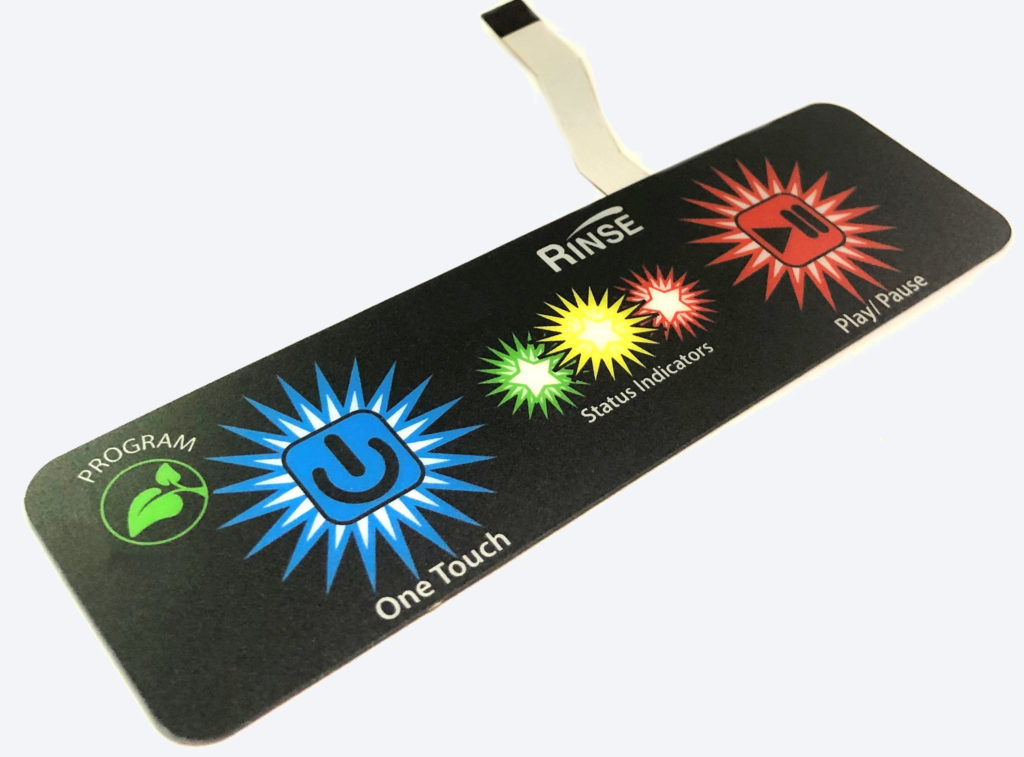
The decorative front layer of a membrane switch or control panel.

KEY HEIGHT

The distance from the highest point of a key to the base of the keypad.

LIGHT EMITING DIODE (LED)

Assembled to the membrane switch circuitry to illuminate a feature or features on the keypad.

PINOUT

The schematic that describes the circuit output requirements for membrane switches. Also known as a wire diagram.

PRESSURE SENSITIVE ADHESIVE (PSA)

Adhesive materials that bond through the application of pressure without the need for heat or solvents.

REAR PSA

A pressure sensitive adhesive applied to the back of a membrane switch for mounting purposes. Different types of rear PSA can be utilized depending on the application and bonding surface.

SHIELDING

Utilizing methods for incorporating ESD/RFI/EMI shielding within the membrane switch layers.

SECOND SURFACE PRINTING

Practice of printing a graphic overlay from the bottom in reverse, so the outer layers protect the graphic.  This is particularly useful in membrane switch applications where the graphic overlay experiences abrasive wear.

SILVER INKS

Tiny particles of actual silver suspended in various substrates that produce conductive patterns on rigid and flexible substrates.

SPACER LAYER

A membrane switch adhesive layer separating the electronic circuit layers with button/switch openings.

TAIL BREAKOUT

The location of the tail exit on the back of the membrane switch.

VENTING

Membrane switch openings connected to one another to seal the switch from moisture and other contaminants without venting externally. External venting is also an option if the design allows for it.

WINDOWS

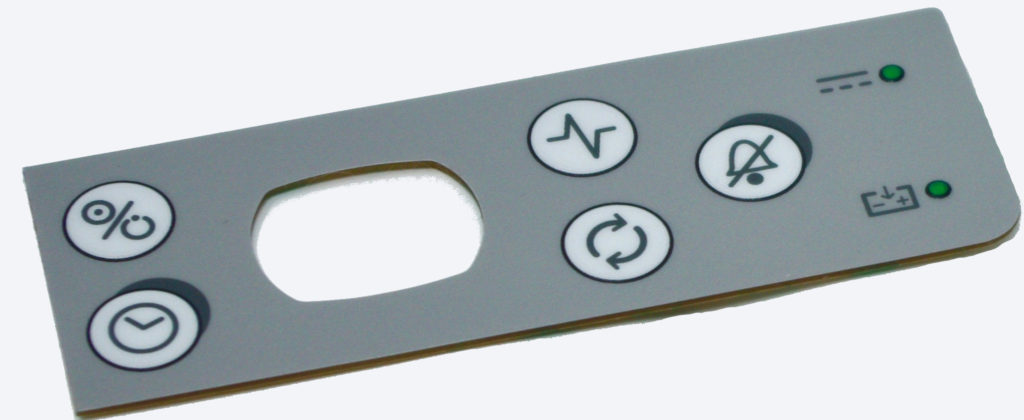
Utilizing the base clear overlay to incorporate windows in a membrane switch typically for displays. Can utilize hardcoats or textures depending on the application. Incorporating a reinforced opti-bond window is also a common technique for windows susceptible to excessive abuse.

WIRE DIAGRAM

A diagram showing the desired connections to the pinout connector.
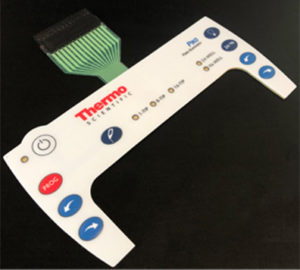
Membrane Switch Copper Flex Circuitry
Membrane Switch Copper Flex
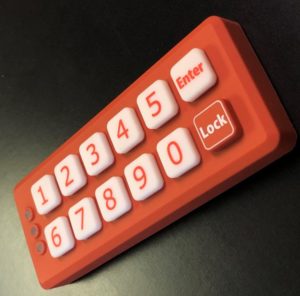
Backlit Rubber Keypads
Membrane Switch Silver Circuit
Sealed Rubber Keypad

Emulating Seven Segment Displays in Membrane Switches

Emulating Seven Segment Displays in Your Membrane Switch or HMI

Are you looking to integrate a seven segment display or displays into your interface but are encountering space constraints and/or trying to keep costs down? 

CSI has years of experience emulating seven segment displays using LEDs, light guide film and light blocking features. We also utilize additional methods including light “piping” features within the layers of the membrane switch. We can integrate LEDs of any color and any window color to give you the exact aesthetic you are looking for in your product. The result is a thinner membrane switch package size at a much more cost effective price.

Advantages:


1. Thinner membrane switch package size.

2. More cost effective than using actual seven segment displays.

3. Can integrate into a flexible circuit (versus printed circuit board).

Of course, if you want to use actual seven segment displays that is also an option but will most likely require a printed circuit board design (versus a thinner flexible circuit) and an overall thicker membrane switch package. The CSI engineering team can assist you in this process in order to ensure you get exactly what you are seeking for your interface.

Seven Segment Displays in Membrane Switches

Preventing Newton Rings in Your Membrane Switch or HMI

Preventing Newton Rings in Your Membrane Switch or HMI

If you’ve ever designed a product with a screen or display you’ve most likely encountered Newton rings. Newton rings are a phenomenon in which a series of concentric colored bands are observed between two pieces of glass or glass-like materials and a layer of air exists between them. The phenomenon is caused by the interference of light waves from both top and bottom surfaces of the air film between the two pieces of glass or glass-like materials. In the case of membrane switches, it is typically the space between the graphic overlay window and a display.

Therefore, it’s critical that Newton rings are accounted for and addressed during any sort of design and assembly involving screens or lenses.

There are essentially three methods for addressing Newton rings:

1. Design an air gap between the graphic overlay window and the display screen.

2. Optically bond the graphic overlay window to the display screen.

3. Print very fine, clear dots on the back of the graphic overlay window.

There is no right or wrong method for addressing the phenomenon and it is really contingent on the product and design. But it’s of the utmost importance that it’s addressed! The CSI engineering team can assist you in this process in order to ensure that there is zero probability of this phenomenon from occurring in your product.

Newton Rings Membrane Switch

The Case Against Printed Silver Circuitry: Embedded Components

The Case Against Printed Silver Circuitry: Embedded Components

We recently had a customer approach us experiencing issues with one of their printed silver circuit membrane switch designs. The customer sent us some samples for our analysis and it was found that the LEDs would function as expected in a flat state but when the tail was pulled back or the keypad flexed, the parts exhibited enough internal force to also flex the LED causing the LED to either fail and/or flicker in some cases. It was then determined that the LED issues were caused by the silver epoxy fracturing where it joins the printed silver ink circuit trace. It wasn’t the LEDs that were failing, but actually the method in which the LEDs were applied to the circuit that was ultimately failing.


When first designing this keypad assembly, the available flexible circuit technology at the time was printing silver ink on polyester film and affixing LEDs to the silver circuit using a silver epoxy paste or glue.  Although, printed silver is still a common method even to this day, it does lack some robustness and does not always achieve the same results for all customers. There are a host of reasons why it can fail, but when it does it is best to upgrade to a more robust design (polyimide circuitry). With the availability of cost effective copper on Kapton flex circuits, we are now able to provide soldered LEDs which are far more reliable than having to rely on an epoxy assembled LED. Being able to traditionally solder LEDs provides an infinitely more reliable part as both the joint and the adhesion of the copper to the polyimide (Kapton) base substrate are much more durable. 


CSI utilizes copper flex circuitry on many similar keypad assemblies that are used in the automotive industry, medical devices, military, marine, etc. Many of which reside in harsh environments and in most cases have withstood and passed extensive testing by our customers before entering production. It is a time-proven and tried-and-true design for CSI and one we have been successfully utilizing for a decade. 

Fluorosilicone Rubber Keypads

Fluorosilicone Rubber Keypads

One of the most frequently asked questions we receive regarding rubber keypads: Is there a rubber keypad material that is oil and fuel resistant? You’ve come to the right place, because we have extensive experience utilizing fluorosilicone material for such applications.

Fluorosilicone rubber is similar to silicone rubber but with fluorine properties. Similar to silicone, fluorosilcone is a stable and extremely durable elastomer that resists compression across temperature extremes. But unlike silicone, fluorosilicone contains trifluoropropyl groups that enhance its chemical resistance to non-polar solvents, fuels, oils, acids, and alkaline chemicals.

Fluorosilicone Advantages:

1. Oil, fuel, solvent and chemically resistant.

2. Heat and cold resistant.

3. Can be decorated using specially formulated inks and treatment agents.

A Heartfelt Thank You to All Visitors at the MDM Tradeshow

A Heartfelt Thank You to All Visitors at the MDM BIOMEDevice Show

CSI Keyboards would like to extend our gratitude to all of the visitors that stopped by our booth last month in Boston. It truly was a pleasure meeting each and every one of you and cannot thank you enough for your support.

The MDM BIOMEDevice Tradeshow has become a beacon in the medical industry allowing companies like CSI to showcase our products and designs enabling individuals to explore innovations, source products, and make vital connections that help grow the industry as a whole.

Thank you again and hope to see you next year!


CSI Keyboards to Exhibit at the MDM BIOMEDevice Show

CSI Keyboards to Exhibit at the MDM BIOMEDevice Show

CSI Keyboards will be exhibiting at the MDM BIOMEDevice trade show at the Boston Convention & Exhibition Center on September 20th-21st. 

Come visit us at Booth 1031.

BIOMEDevice focuses on the medtech research, development and products that matter to you, get continuing education experience to keep you current in the industry and on the job. Then explore innovations, source products, and make important connections. 

Design & Manufacturing (D&M) New England is your entryway to the most advanced technologies on the market, from design software and biotech solutions, to contract manufacturing, automation, and robotics. Walk the entire expo floor and meet face to face with thousands of peers while gaining valuable insights from industry pros across the medtech, design and manufacturing, and embedded systems spectrum.

Spanning the embedded systems spectrum, the Embedded Systems Conference brings together engineers searching for solutions with leading suppliers whose products can reduce cost and efficiency.

Most Suitable Graphic Overlay Material for UV Resistance

Most Suitable Graphic Overlay Material for UV Exposure

A very common question many customers ask us: is there a graphic overlay material that is better suited for a product that will live outside with constant UV exposure?

The answer to this question is really dependent on the membrane switch design.

If the membrane switch doesn’t have a window, then the polyester Autotex XE would be ideal.

If the membrane switch does have a window, then we have found that the best UV resistant graphic overlay material is actually polycarbonate as there is no available UV polyester (including Autotex XE) that is non-textured which would be required for any part with a window. 

When it comes to UV resistant polycarbonates, these are really the best available material options:

HP92W: UV resistant gloss hard coat – non-texturable

HP92X: UV resistant – texturable

Thicknesses:

.007 (7mil) is needed for anything that requires an emboss

.010 (10mil) can be used for parts that don’t require an emboss or standalone windows.

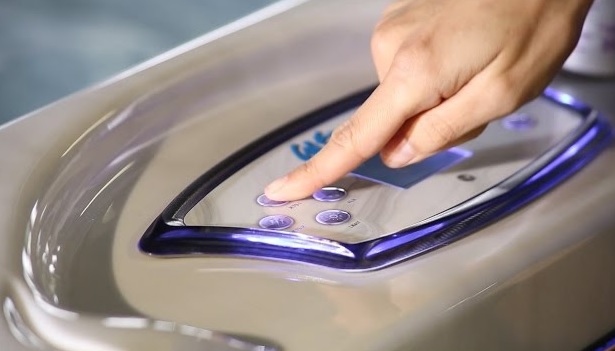
Hot Tub Keypad

Utilizing Epoxy Keys in Membrane Switches

Utilizing Epoxy Keys in Membrane Switches

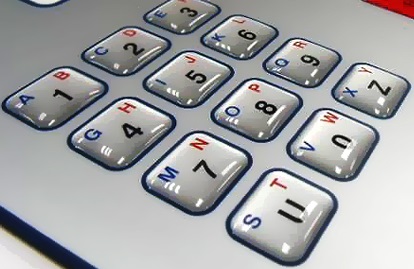
Often times, membrane switches are simply embossed which is the process of raising the key area using magnesium membrane switch overlay embossing dies. A popular alternative to embossing the overlay material is using epoxy keys.

Epoxy keys are applied using a precise dispensing process. Epoxy keys are typically used for aesthetic purposes giving the membrane switch a clean look and really making the keys pop. Epoxy keys are still raised off of the surface allowing the user to easily locate the keys similar to an emboss.

Epoxy keys are also utilized when there are space constraints around the keys. If the keys are too close together or close to the edge of the part, there often times isn’t enough space to emboss due to adhesion issues. The epoxy keys ensure there is enough adhesion around the keys to prevent delamination.

Epoxy Keys in Membrane Switch

Backlighting Membrane Switches with Fiber Optics

Fiber Optic Backlighting in Membrane Switches

Backlighting membrane switches with fiber optics provides many benefits that cannot be obtained using standard LED backlighting or EL techniques.

Advantages:

1. Fiber optics provides a flexible and customizable back lighting layer (as thin as 0.2 mm) that can easily be incorporated between the graphic overlay and the circuit layer.

2. Can evenly backlight the entire surface area of the membrane switch.

3. Fiber optics allow for a uniform and evenly distributed backlit surface.

4. Low power consumption typically only using one single LED.


Fiber Optic Membrane Switch