When a Non-Tactile Membrane Switch Makes Sense

When a Non-Tactile Membrane Switch Makes Sense

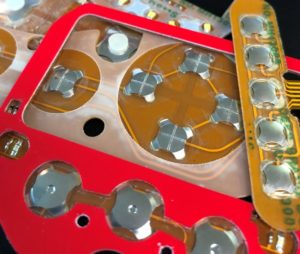
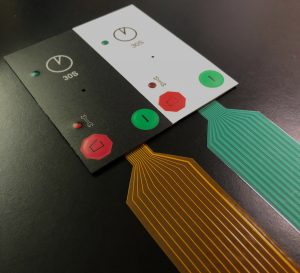
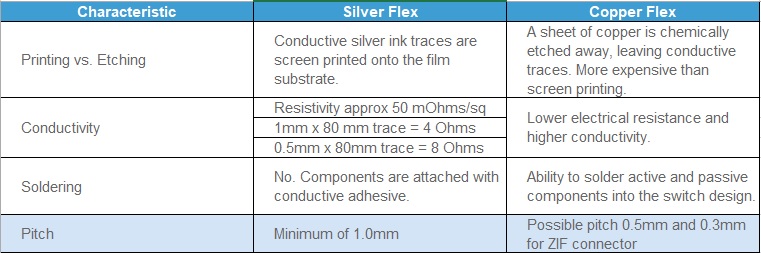
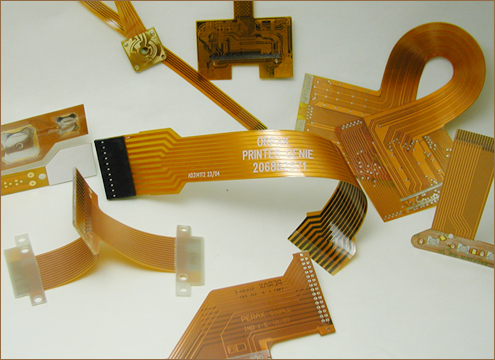
A non-tactile membrane switch is a switch that lacks snap or tactility when pressed or actuated. Non-tactile membrane switches are constructed of copper flex circuity using polyimide Kapton as the base material. Copper flex keypad switches are manufactured by laminating a thin sheet of copper to a flexible film substrate. The copper is then chemically etched away, leaving the copper traces. An additional layer of polyimide is laminated to the circuit leaving the gold contacts exposed.

Non-tactile membrane switches are typically designed into a product due to one of the following reasons:

  1. The Need for Dense Traces to Create a Sensor or Slider Interface: typically in user interface designs where the customer is looking for a sensor or slider interface solution, where the user can run his/her finger along the surface and make contact/actuation. CSI can integrate added points, ribs, or sections providing tactile feedback. The advantage of this product is that it does not require any sensor electronics, and has no moving parts. The solution is extremely robust and cost effective. It’s a great alternative to more expensive and sophisticated capacitive touch solutions. 
  2. Size Constraints: when there simply just isn’t enough room for domes due to the small size of the design.
  3. Light Activation Force: the customer wants to simply be able to run their finger over the key with a very light press in order to make contact ie does not want any snap when pressing the key.

Advantages of Copper Flex Membrane Switches

  • Improved creasability – the ability to fold or crease without causing open circuits which you are susceptible to using silver ink
  • Ability to put solder components directly on flex, better adhesion than bonding to silver ink
  • Much more resistant to thermal shock
  • No potential problems with silver migration
  • Greater conductivity
  • Lowering the closed loop resistance and switch bounce will be reduced by gold plating the contacts. We will have a gold to gold contact with no bounce versus silver to gold dome
  • Applying stiffener to tail end using heat lamination versus cold lamination which provides better adhesion and better for pinning
  • Ability to have a 0.5mm pitch vs. the 1.0mm minimum with printed silver
  • Tighter trace routing capabilities

Backlighting Copper Flex Membrane Switches

LEDs: 

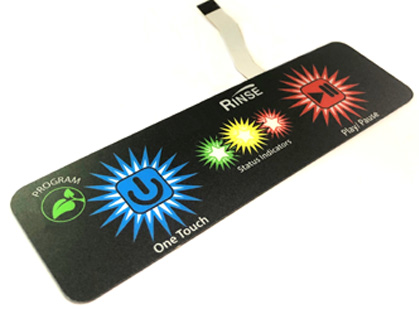
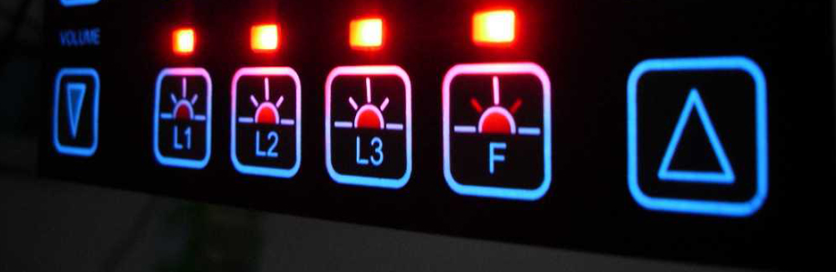
LEDs are the most popular and economical method for keyboard backlighting. LEDs are a great option for backlighting non-tactile membrane switches, as they can be easily integrated into the flexible circuit and act as indicator lights providing visual feedback for users, since they don’t feel the snap of a switch when they pressed. LEDs are most commonly used to backlight keys, icons and symbols. LEDs are also typically used as indicator lights. A combination of LEDs, Light Guide Film and proprietary CSI backlighting methods can be designed to backlight the entire surface of a user interface.

Light Guide Film (LGF): 

Light Guide Film is designed to evenly distribute light from top or side firing LEDs, providing bright, uniformed illumination. It also reduces the amount of LEDs needed, saving power consumption. More on light guide film technology below. The design and utilization of light guide film (LGF) technology has become one of the most common methods of interface backlighting. CSI Keyboards uses proprietary techniques to design the light guide film so it is optimized for light redirection and reflection giving the customer the brightest possible backlighting solution. Light guide film dots are also designed and implemented which allow for the optimization of light distribution to obtain maximum brightness and uniformity. Common problems that many of our competitors face are light leakage and hot spots. CSI’s backlighting designs prevent any light leakage and hot spots from occurring, and also result in much brighter light guide film and interface.

Electroluminescence (EL): 

EL is applied on a very thin layer between the graphic overlay and the circuit. EL uses a printable ink deposit to illuminate the switch and provide a uniformed illumination.

Fiber Optics: 

Fiber Optics provide a flexible back lighting layer that can be incorporated between the graphic overlay and the circuit layer allowing the entire surface area of the membrane switch to be evenly backlit.
Benefits of Using Copper Flex Circuitry

The Benefits of Using Copper Flex Circuity vs. Printed Silver

CSI Keyboards uses copper flex circuitry in the majority of our custom keypad designs due to its excellent dielectric strength, thermal stability, chemical resistance and flexibility. Copper flex, also known as Kapton circuits, have become the superior choice over printed silver especially for outdoor applications. 

A printed silver circuit can be replaced with a copper and polyimide construction with minimal additional cost. Copper flex circuitry construction designs offer a significant advantage over printed silver.

Copper Flex membrane switch panels are produced using polyimide (Kapton) as the base material. Copper flex keypad switches are manufactured by laminating a thin sheet of copper to a flexible film substrate. The copper is then chemically etched away, leaving the copper traces. An additional layer of polyimide is laminated to the circuit leaving the gold contacts exposed.

Advantages of Copper Flex Circuitry vs. Printed Silver

  • Improved creasability – the ability to fold or crease without causing open circuits which you are susceptible to using silver ink
  • Ability to put solder components directly on flex, better adhesion than bonding to silver ink
  • Much more resistant to thermal shock
  • No potential problems with silver migration
  • Greater conductivity
  • Lowering the closed loop resistance and switch bounce will be reduced by gold plating the contacts. We will have a gold to gold contact with no bounce versus silver to gold dome
  • Applying stiffener to tail end using heat lamination versus cold lamination which provides better adhesion and better for pinning
  • Ability to have a 0.5mm pitch vs. the 1.0mm minimum with printed silver
  • Tighter trace routing capabilities

Printed Silver vs. Copper Flex

The Case Against Printed Silver - "Silver Migration"

The biggest case against using printed silver circuitry and thus using copper flex circuity is a phenomenon known as silver migration which occurs in microelectronics, components, PCB assemblies and membrane switches. Silver migration is the ionic movement of silver between two adjacent traces that inevitably results in a temporary electrical short.

Silver is a very active metal and is thus highly susceptible to silver migration or dendrite growth. Yet it is also a very cost effective metal for the electronic industry because of it’s conductively and usability. With the reduction or elimination of lead in electronics, silver is a very attractive choice because of its solderability and conductivity.

Silver Migration with Membrane Switches

Silver migration in membrane switches was a much bigger problem in the 1970’s and 1980’s; mainly because of the technical inability of the membrane switch manufacturers. In some cases these manufacturers were graphic screen printers who could screen print silver paste, but had little understanding of electronics or reliability issues associated with the electronics industry.

Today, with competent membrane switch manufacturers, silver migration is less of a problem. However, there are situations such as severe environments or design constraint issues where silver migration is still a risk. As in all aspects of electronics, the industry drive to reduce space and reduce costs with increased functionality continually pushes the envelope for designers and manufacturers of membrane switches.

Causes of Silver Migration

Two factors are typically required to create silver migration in a circuit using silver as the conductor:

1) A voltage potential between two traces. 

2) The presence of moisture. 

Ways to Reduce or Prevent Silver Migration

Some or all of the following solutions can be used to reduce or prevent the occurrence of silver migration.

  • Modifying the silver composition with palladium or copper. 
  • Covering the silver traces with an inert coating such as a protective carbon layer and/or an overcoat dielectric.
  • Increasing the conductor spacing between traces that have a voltage potential.
  • Reducing the voltage.
  • Preventing moisture penetration greatly reduces the risk of dendritic growth. Gasketing and sealing technology can stop the ambient penetration of moisture; elevated temperatures will make it necessary to utilize other methods to reduce migration.
  • There are several areas of a membrane switch that are more susceptible to water damage because they are collection points for moisture or allow moisture to easily penetrate such as terminations, tail break-outs, areas with low adhesion

Membrane Keypads vs. Mechanical Switches

Mechanical Switches vs Membrane Switches

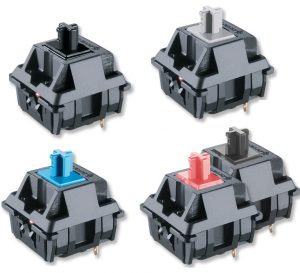
Keypads can generally be broken down into one of two different categories: membrane switches and mechanical switches. While their primary purpose is the same they are completely different solutions.

Membrane Switches

Mechanical Switches

So What’s the Difference?

The main difference between mechanical switches and membrane switches is the overall construction. Membrane keypads are essentially assemblies that are not separate moving parts. They feature pressure pads on a flat circuit. Membrane keypads work by using an electrical contact underneath the keys’ surface. When a key is pressed, it makes contact with the circuit registering the key press. Membrane switches typically utilize metal domes to make contact and provide tactile feedback. Dome switch keypads use two circuit board traces in conjunction with a metal dome. Metal domes, which are typically made of stainless steel, are momentary switch contacts that provide tactility or “snap” when pressed. The domes become normally-open tactile switches when actuated on the circuit. More on domes switches can be found here.

Maintenance & Sealing

Another critical difference between mechanical and membrane switches is their maintenance requirements. Because membrane keypads are embedded into the components, there’s no way for dust, dirt and debris to enter the circuitry as there are no openings. As such, cleaning a membrane keypad is far easier and less time consuming than cleaning a mechanical keypad. It is also much easier to seal a membrane keypad versus a mechanical switch.

Cost

There is a false pretense that membrane keypads are more expensive than their mechanical counterpart, but this isn’t necessarily true. In actuality, membrane keypads typically cost less than mechanical switch solutions, making them an attractive option for customers with high volumes. Because the keys are all integrated together without moving parts, membrane keypads are easier to manufacture resulting in a lower price for the end consumer.

Epoxy Key Top Coating for Rubber Keypads

Epoxy Key Tops for Rubber Keypads

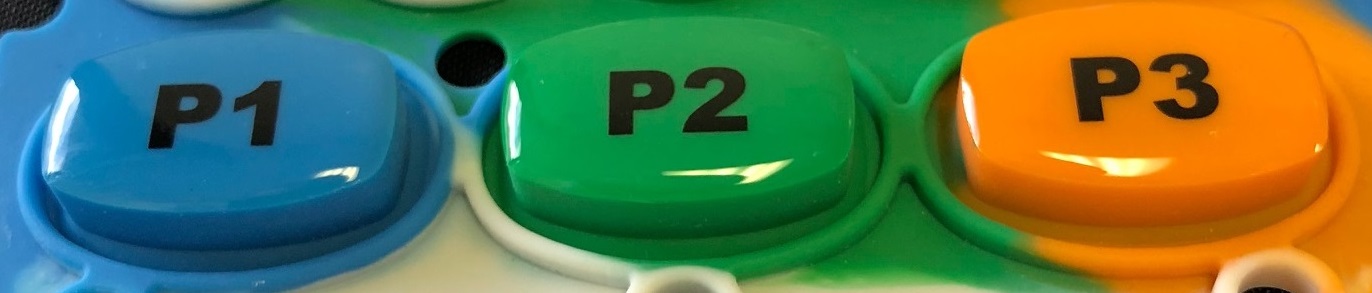
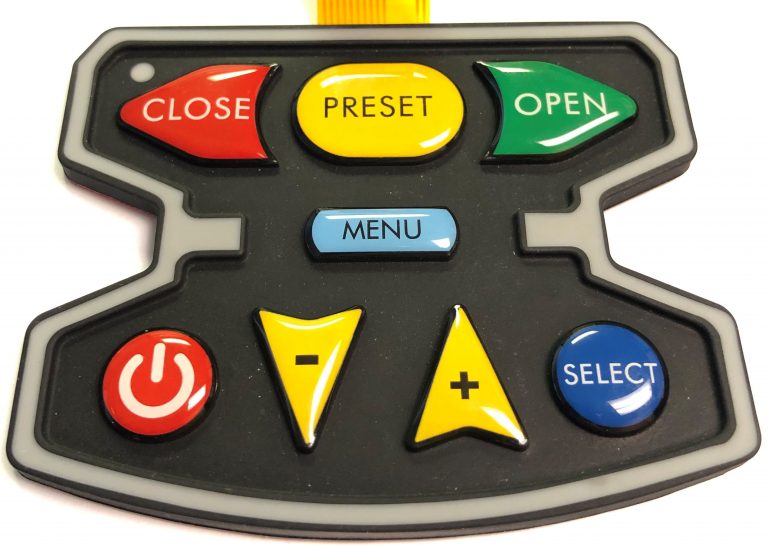
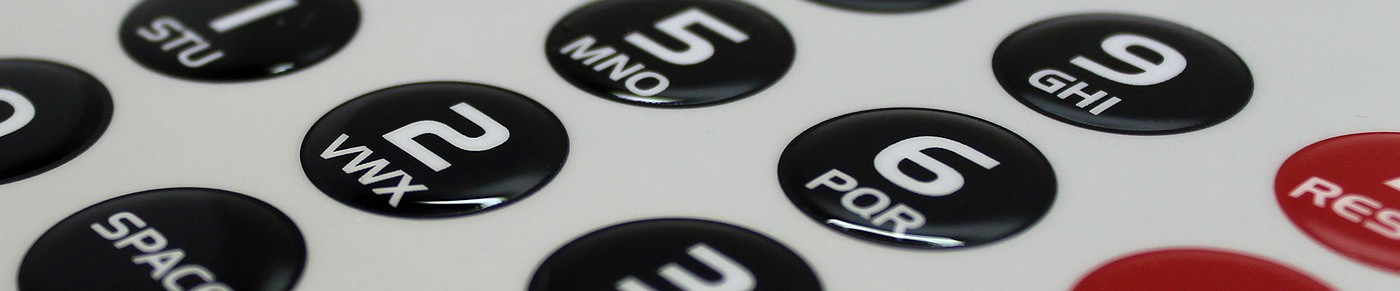
Epoxy key top coating is a protective clear epoxy resin coating applied to only the silicone rubber key tops. This thick coating gives keys a hard plastic feel and glossy appearance. Epoxy coating can extend the longevity of key top artwork as it has abrasion resistance and protects the tops of the keys from chemicals, dirt and oils. 

The epoxy key tops can really make your product stand out from the competition as it is more visually appealing than standard rubber key tops. The keys have a plastic appearance but producing the epoxy coated rubber keypads is considerably less cost than manufacturing plastic keys. We recommend epoxy key top coating for keys that receive a high number of actuations or applications that are exposed to abrasion. Additionally, the epoxy coated keys can also be backlit similar to a standard rubber keypad. The rubber is laser etched prior to the epoxy being applied to the key tops.  

How Do I Get Started?

How Do I Get Started?

CSI just needs to collect a few details on your product and design. Once we obtain some preliminary information on your design, we can begin the quoting and proposal process.

Please provide any mechanical drawings (DWG, DXF, IGES, STEP) and artwork files (AI or CDR) if available.

  • Molded rubber or polyester overlay?
  • Copper flex circuit or printed silver?
  • Mechanical dimensions – height and width of part, keys, etc.
  • Artwork/Graphic Overlay if not, how many colors (Pantone #s)?
  • Embossed (plateau/pillow or rim)?
  • Tactile feel (domes)?
  • Any backlighting?  Any LEDs?
  • Length of tail and tail break out location?
  • What type of connection?  Female connector or prep for ZIF?
  • What type of environment?  Does the keypad need to be environmentally sealed?
  • Are there any windows?  Do they need to be reinforced (opti-bonded)?
  • Is there a display and would you like us to integrate it into the interface?

Other Key Considerations

  • Space between keys and around perimeter of keypad should be .100” or better. 
  • .100” center to center min for tail with connector. 
  • 1mm center to center min for ZIF type interconnect. 
  • Tail exit should be .25” min. from edge, keys and other components (tail cannot exit under key). 
  • Normal final assembly tolerances = size +/- .010”, die cut to image = +/- .010” 

What Are Metal Domes and How Do I Choose the Right One?

What are Metal Domes and How Do I Choose the Right One?

What are metal domes and how do I choose the right one for my membrane switch? This is one of the most common questions that is raised by our customers during the design process. 

So what is a metal dome?

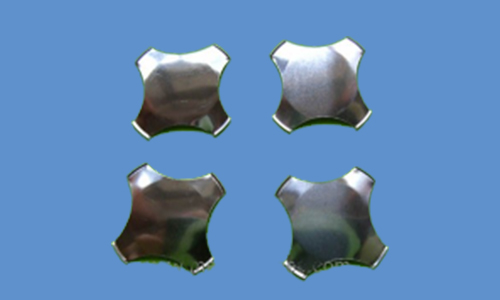
Metal domes (metal snap domes, or tactile metal domes), made of stainless steel, are momentary switch contacts that, when used in conjunction with a PCB, flex circuit, or membrane, become normally-open tactile switches. All of the domes that CSI designs into our products are rated for at least one million cycles.

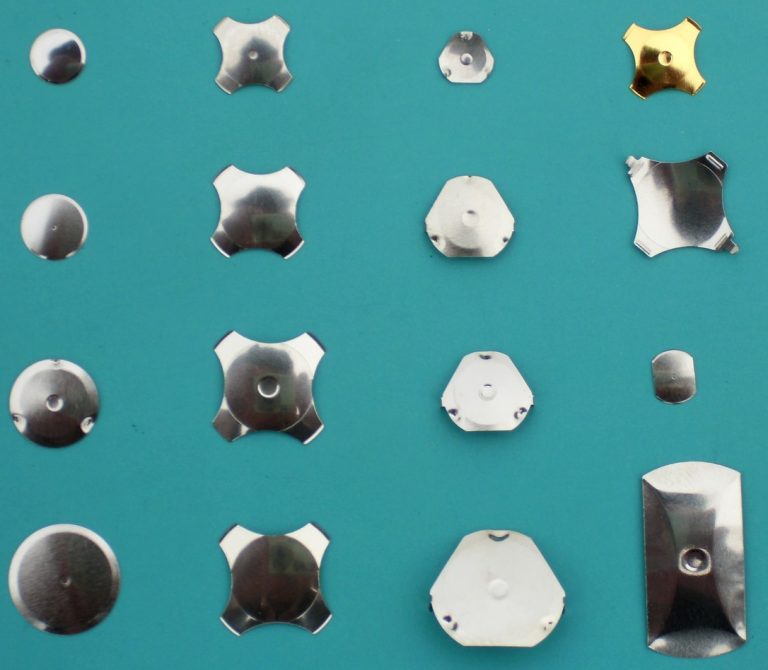
Domes typically come in the following shapes:

  • Four legged
  • Triangle
  • Round 
  • Oblong
  • Custom
 

How do I choose the right one?

The CSI engineers will work very closely with you in deciding which dome is best for your application. Typically the decision is based on the force of the dome (how soft or hard of a press it takes to actuate the dome). CSI can also mock up different sample keypads with different dome options so the customer can decide through a more “hands-on” approach.

Integrating Light Guide Film Backlighting

Integrating Light Guide Film Backlighting

CSI Keyboards is a global leader in membrane switch backlighting and interface backlighting technology. CSI has over 35 years of experiencing backlighting user interfaces, from as simple as backlighting a logo to backlighting individual keys to backlighting the entire interface surface. CSI’s backlit products include: backlit human machine interfaces, backlit membrane switches, backlit elastomeric keypads and backlit panels or signage.

Why Light Guide Film?

CSI integrates Light Guide Film (or LGF) into many of our backlit keypad interfaces and membrane switches. Light Guide Film is a thin film that will direct light produced by side-firing, or right-angle, LEDs across the area that needs to be backlit. The film is placed directly below the graphic overlay and above the circuit layer so that the light will not be obstructed by any circuit traces or tactile components. This film can be cut into any pattern or shape within your switch. Multiple LGF films can also be used within one application to provide discrete backlighting to different graphic features. Different colored LEDs can be used to achieve unique lighting effects or white LEDs can be used to light different printed graphics on the overlay.

It is critical that the LEDs are properly placed on the circuit in order to adequately light the intended area. CSI will carefully evaluate the placement of these LEDs to ensure adequate light distribution and to avoid any hot spots.  

There was a time when the only way to backlight interfaces was to use standalone LEDs or EL panels. The problem with using LEDs without LGF is the creation of hot spots and uneven dispersion of light. EL panels are not only expensive, but they are not as bright as today’s LEDs. LGF is extremely thin so it can be incorporated into membrane switches that can’t exceed a certain thickness.  It can provide even backlighting across large and small areas, and for applications where the light remains on while the switch is powered.

Backlighting Membrane Switches

Backlighting Membrane Switches

Membrane Switch Backlighting

CSI Keyboards has been backlighting membrane switches, HMIs and user interfaces for over thirty five years. We’ve used backlighting techniques from the simplest LED membrane switch using a single colored LED indicator with a transparent smoked LED window (to hide LED from surface), to the most complicated multi-colored membrane keypad switch assembly. We can bring your product to life and make it truly stand out from your competition. Typical backlit designs include: backlighting keys, nomenclature, logos, perimeters, indicators, or the entire keypad.

Rubber Switch Backlighting

When it comes to elastomeric rubber keypad backlighting, CSI has the expertise to utilize and take advantage of molded silicone rubber which is an excellent conductor of light. CSI Keyboards utilizes translucent rubber, laser etching, light piping technology as some of our many techniques.

Backlighting Solutions

LEDs: LEDs are the most popular and economical method for keyboard backlighting. LEDs are most commonly used to backlight keys, icons and symbols. LEDs are also typically used as indicator lights. A combination of LEDs, Light Guide Film and proprietary CSI backlighting methods can be designed to backlight the entire surface of a user interface.

Light Guide Film (LGF): LGF is designed to evenly distribute light from top or side firing LEDs, providing bright, uniformed illumination. It also reduces the amount of LEDs needed, saving power consumption. More on light guide film technology below. CSI Keyboards uses proprietary techniques to design the light guide film so it is optimized for light redirection and reflection giving the customer the brightest possible backlighting solution. Light guide film dots are also designed and implemented which allow for the optimization of light distribution to obtain maximum brightness and uniformity. Common problems that many of our competitors face are light leakage and hot spots. CSI’s backlighting designs prevent any light leakage and hot spots from occurring, and also result in much brighter light guide film and interface.

Electroluminescence (EL): EL is applied on a very thin layer between the graphic overlay and the circuit. EL uses a printable ink deposit to illuminate the switch and provide a uniformed illumination.

Fiber Optics: Fiber Optics provide a flexible back lighting layer that can be incorporated between the graphic overlay and the circuit layer allowing the entire surface area of the membrane switch to be evenly backlit.
MD&M BIOMEDevice Tradeshow Recap

MD&M BIOMEDevice Tradeshow Recap

Considered to be New England’s biggest medtech showcase, the BIOMEDevice Boston once again did not disappoint. Whether your focus is new materials, intelligent sensors, testing solutions, components, or anything else in the medtech arena, source cutting-edge products and services in a time-saving format with more than 450 solution providers across the full spectrum of medtech manufacturing.

The 2018 MD&M BIOMEDevice Show print show at the Boston Convention & Exhibition Center was full of inspiration. Boston, MA was bustling with manufacturers, medical device companies, and design houses from near and far. This was the fourth year CSI Keyboards has exhibited at the Conference. It has proven to be an excellent venue for meeting engineers from not only all around the country, but the whole world. CSI is able to showcase our wide range of products including membrane switches, rubber keypads, touch screen interfaces, and our many other user interface and HMI solutions. Being able to exhibit samples of our products allows engineers, buyers or even just the casual or curious passerby to “play” with our products hands-on. It was also great seeing many of our existing customers stop by our booth to chat and learn about some of new products and capabilities. Until next year, Boston!

Polyurethane Coating for Rubber Keypads

Polyurethane (PU) Coating for Rubber Keypads

Polyurethane (or PU) is a protective overcoat applied to rubber keypads. This clear coating provides wear resistance for very high use applications or products that are used in harsh environments. Adding the polyurethane coating to rubber keypads ruggedizes the keypad, increases abrasion resistance, adds UV resistance and prolongs the longevity of the rubber. It provides superior resistance to corrosion andchemical exposure. This particular coating is also a cost effective solution. 

PU coatings protect rubber keypads from oils, dirt, and contamination. The polyurethane may be applied in a glossy or matte finish, to meet the aesthetic requirements of the rubber keypad. The polyurethane coating is deposited on the top surface of the keypad over the printing. Polyurethane coatings are used across all industries to improve the appearance and lifespan of the materials.